Photo Stitch Mountains 2: A Thoughtful Designer’s Review
As a designer who’s stitched thousands of embroidery files for clients, boutique brands, and my own craft business, I approach every new machine embroidery design with equal parts curiosity and caution. When Photo Stitch Mountains 2 landed in my inbox—touted as a “photo stitch” mountain motif—I paused before opening it. Not because I doubted its appeal, but because photo-stitch designs live or die by their translation from screen to fabric. So I tested it—not just on my embroidery machine, but on real projects: a linen tea towel for a local café, a cotton tote for a hiking-themed Etsy shop, and a soft organic cotton baby onesie. Here’s what Photo Stitch Mountains 2 actually delivers—and where it asks for your thoughtful attention.
A First Impression That Feels Like Breathable Space
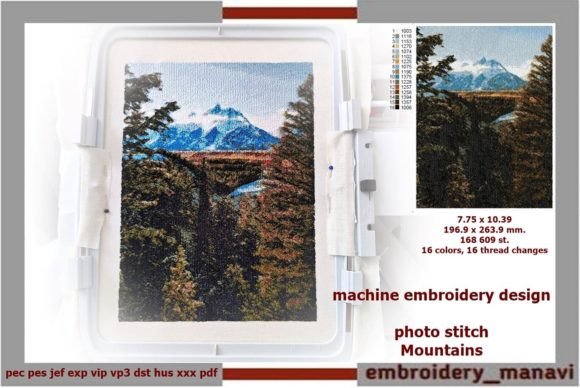
The moment you preview Photo Stitch Mountains 2, it doesn’t shout. It settles. There’s a quiet, layered depth to the mountain silhouette—soft gradients implied through stitch direction and density rather than hard edges or excessive detail. It leans into the “photo stitch” aesthetic without overloading the file: no tiny jagged peaks that’ll vanish in satin stitch, no fragile wisps that’ll fray on a tote bag after two washes. It reads as home decor first—calm, grounded, intentional—but carries enough visual weight to hold up on apparel. If Photo Stitch Mountains 2 had a personality, it’d be the kind of designer who chooses linen over polyester and values negative space as much as stitch count.
Where It Shines: Real Projects, Real Customers
I used Photo Stitch Mountains 2 on a heavyweight natural canvas tote for a small outdoor gear shop. Paired with oat-colored thread on undyed fabric, it looked handmade—not mass-produced. The stitch density felt balanced: dense enough to read clearly at arm’s length, open enough to avoid stiffness or puckering. For a holiday gift line, I stitched it onto wool-blend pillow covers—it held texture beautifully, and customers commented on how “peaceful” and “uncluttered” it felt compared to busier nature motifs.
It also worked well as an ITH embroidery project: I stitched it cleanly onto a lightweight cotton patch, then fused it onto denim jackets for a pop-up market. No skipped stitches, no thread breaks—even at moderate speed. As a tote bag design or sweatshirt embroidery, it lands with quiet confidence. It doesn’t compete with logos or slogans; it complements them. For an Etsy seller building a cohesive “slow living” brand, Photo Stitch Mountains 2 is a reliable, mood-aligned asset—not just another mountain clipart knockoff.
Where It Asks for Your Judgment
This isn’t a “set and forget” design. On thin or stretchy fabrics—like lightweight jersey for baby onesies—I added tear-away + cutaway stabilizer combo and slowed my machine down. Without that, the fill stitch areas softened too much, losing definition in the mid-mountain ridge. On dark fabric, I tested thread contrast carefully: a medium-gray thread read well on navy, but light beige disappeared entirely. Always check your thread colors against your fabric texture before stitching the final piece.
For curved surfaces like caps or hats? I’d recommend resizing Photo Stitch Mountains 2 down slightly—or choosing a simpler variant—unless you’re using a cap frame and have experience managing distortion in wide, low-profile layouts. And while it’s lovely on tea towels and aprons, avoid placing it directly over seams or high-flex zones (like elbow patches) unless you’ve reinforced the back with extra stabilizer.
What It Adds to Your Finished Product—Beyond the Stitch
Photo Stitch Mountains 2 elevates perceived value without demanding premium pricing. Its restraint makes handmade products feel intentional, not rushed. Customers notice that. On personalized gifts—a custom embroidered blanket for a new parent, or a nursery wall hanging—it communicates care, not cliché. For a craft business, that builds trust. For an embroidery project meant for resale, it supports brand consistency across product lines: same calm tone on a sweatshirt, a pillow cover, and a printable mockup for your website.
It also performs well in digital previews. Because the composition is clean and centered, it translates clearly into flat-lay photos and lifestyle mockups—no awkward cropping, no lost detail in thumbnail size. That matters when you’re listing on Etsy or updating Instagram stories for your small shop product launch.
Practical Notes Every Designer Should Run Through
- Always test on scrap fabric first—especially if pairing with textured or dark materials.
- Review stitch density visually before stitching: look for overly tight fills that might cause stiffness or gapping.
- Confirm hoop size compatibility—if you’re working with smaller hoops (e.g., 4x4), check whether resizing compromises key details.
- Inspect small details in the preview: are ridgelines crisp? Does the base gradient fade smoothly, or does it pixelate?
- Test black-and-white mockups to assess contrast and silhouette strength—this reveals how well it’ll read on varied backgrounds.
- Use proper stabilizer—medium-weight cutaway works best for apparel; tear-away suffices for stable home decor items like towels or pillow covers.
- Verify licensing terms before selling finished items or bundling Photo Stitch Mountains 2 as part of a digital product pack.
A Design That Fits Quietly—But Stays Memorable
Photo Stitch Mountains 2 won’t dominate a room, but it lingers in memory. That’s rare in the Embroidery category—where so many nature-themed files default to bold outlines or hyper-realism. Instead, it invites pause. It fits naturally within the Around The World theme not through literal geography, but through shared human resonance: mountains as stillness, as endurance, as quiet awe.
If you’re curating design assets for a handmade product line—or selecting embroidery files for client work—Photo Stitch Mountains 2 earns its place not because it’s flashy, but because it’s faithful: faithful to fabric, to function, and to the people who’ll hold, wear, or gift the finished piece. It’s the kind of machine embroidery design that reminds you why you started stitching in the first place—not to fill space, but to honor it.